
The Infrastructure Gap
Something is shifting—and we now have evidence of what that shift looks like.
In 2024, Jeffrey Gibson became the first Indigenous artist to represent the United States with a solo presentation at the Venice Biennale—ninety-two years after the pavilion was established. By late 2025, he had opened at Hauser & Wirth Paris, mounted a commission on the façade of the Metropolitan Museum of Art, and debuted his first European museum exhibition at Kunsthaus Zürich. Tate acquired two of his works through its North American Acquisitions Committee—part of a broader pattern that has brought work by Sky Hopinka, Tanya Lukin Linklater, Shuvinai Ashoona, and James Luna into the collection.
A door opened. The question is whether anything gets built behind it.
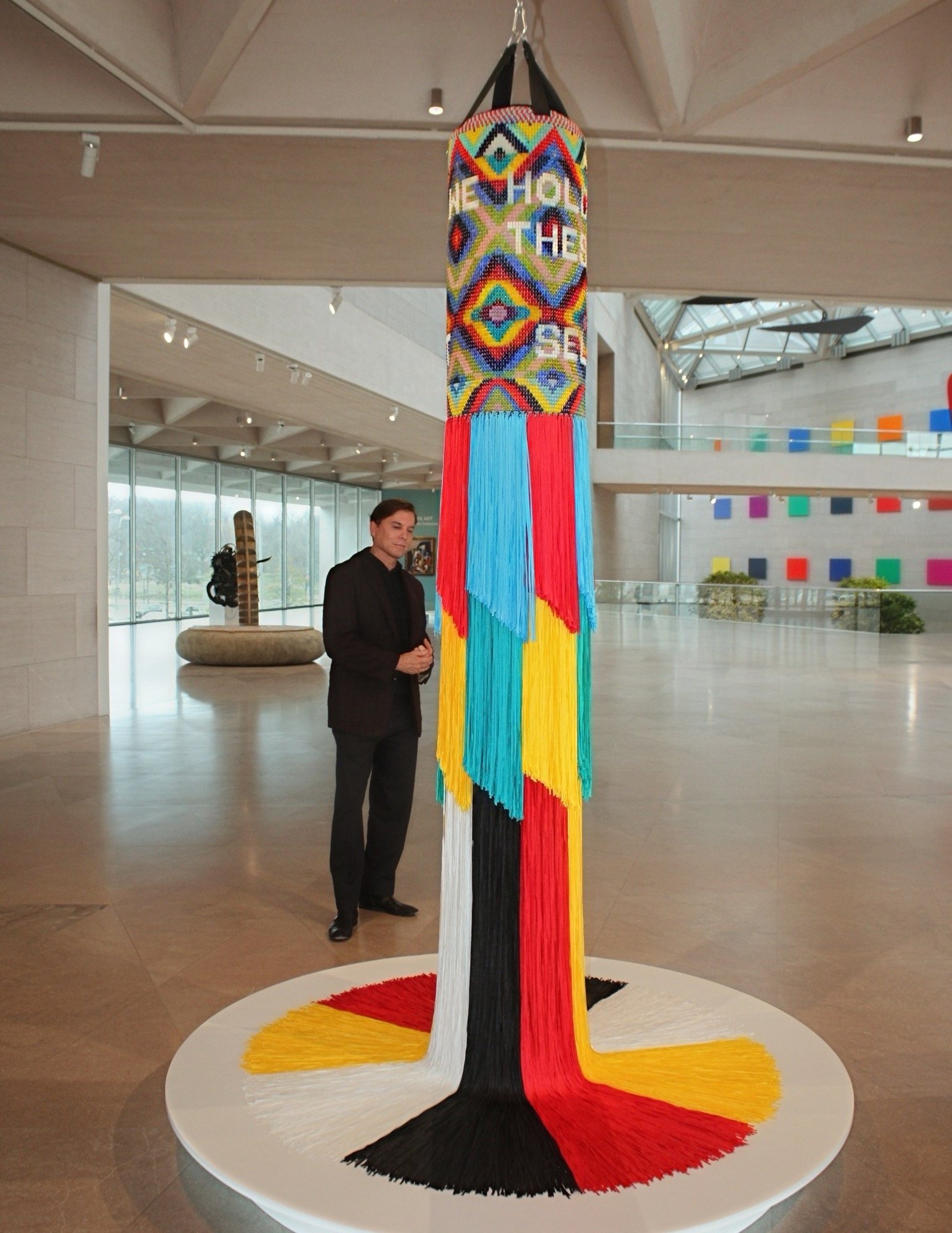
This isn't only about visibility. It's about whether Native contemporary art becomes a repeatable category of influence—recurring acquisition, sustained exhibition, institutional follow-through—or whether it remains a cycle of periodic discovery, celebrated and quietly contained.
Consider Emmi Whitehorse. For more than four decades, she has developed an abstraction grounded in Diné philosophies of land and time. Her work is held by the Whitney, the Brooklyn Museum, the National Gallery—yet until recently, she remained relatively unknown in Europe. Then, in quick succession: four paintings in the central exhibition of the Venice Biennale; a solo presentation at White Cube Paris, her first in Europe in over forty years; and in 2026, a two-part retrospective at the Wheelwright Museum. These are signals of infrastructure forming: repetition, recurrence, institutional memory.
But one case is not a pattern.
Marie Watt and Nicholas Galanin have received major awards, museum acquisitions, and biennial invitations. Yet neither has entered the international gallery infrastructure that produces sustained visibility in Europe and Asia. Awards don't build circulation. Networks do. Biennials generate attention. They don't automatically generate a market spine.
None of this diminishes the foundational work done by smaller galleries, regional museums, and specialized curators who took early risks. Galleries like Bockley; institutions like the Wheelwright and the Eiteljorg—this is the soil from which careers grow. But domestic recognition does not automatically convert into international circulation. That requires a different layer: mega-gallery networks, European institutional pipelines, the mechanisms that turn individual careers into durable categories.
The comparison to Emily Kame Kngwarreye clarifies what's at stake. Beginning in the late 1980s, her paintings entered Australian national collections through sustained acquisition and curatorial advocacy. European placement followed—not as a gesture, but through repetition, scholarship, touring exhibitions, and curatorial continuity. By the time Tate Modern mounted its retrospective in 2025, the groundwork had been laid for decades.
Visibility did not produce infrastructure. Infrastructure produced visibility.
For Native artists, visibility has consistently outpaced the infrastructure needed to sustain it. That asymmetry is the problem.
Hauser & Wirth's representation of Gibson marks a structural threshold. Whitehorse's presentation at White Cube—not representation, but a meaningful signal—suggests at least one other mega-gallery is testing whether this category can sustain European attention.
Meanwhile, the acquisition landscape is shifting. In 2025, Art Bridges and Crystal Bridges acquired 90 works from the John and Susan Horseman Collection; one-third of the Art Bridges lending collection is now contemporary Indigenous art. The de Young reopened its Native American galleries after a years-long overhaul led by a predominantly Native curatorial team, integrating contemporary commissions alongside ancestral works. That matters because international circulation follows curatorial category. When Native work is treated as "traditional," it's quarantined—acquired, exhibited, and loaned through different channels.
These developments don't yet constitute a system. But they constitute early signals of one.
If the shift is real, we should see, in the next three to five years: acquisitions in depth (multiple works by multiple artists entering the same collections); recurring exhibitions (not one-offs, but sustained institutional attention); and international gallery representation across more than one artist. Hauser & Wirth represents Gibson. No mega-gallery has signed a second contemporary Native American artist. This remains the clearest structural gap.
Artists navigate and shape these systems—their choices and strategies matter. But individual navigation cannot substitute for systemic infrastructure. The point is not that artists lack agency; it's that agency alone has not been enough.
Gibson's breakthrough opened a door. The question is whether the system will build a corridor—or simply note that the door was opened, and move on.
If not, we'll get another headline, another "moment"—and the same old architecture.
Written By Reid Walker, Walker Youngbird Founder