
Collecting with Purpose | The Artwork of Beau Dick
Diving deeper into the meaning behind acquisitions to the Walker Youngbird Collection, Reid Walker asked questions of Director and Curator LaTiesha Fazakas, who has been dedicated to studying contemporary Indigenous art since 1998. She is the Director / Curator of Fazakas Gallery and a longtime friend and scholar of the work of Beau Dick and its place within cultural and political movements and contemporary art.
How Beau Dick's work entered the world
RW- You worked with Beau for nearly twenty years. For someone encountering his work for the first time, how would you describe the experience of watching him carve — and what did that process reveal about how he understood his relationship to the material?
LF- Watching Beau Dick carve was not a spectacle so much as an invitation into community. The act of carving was rarely solitary for him; it often unfolded among friends, family, and fellow carvers, becoming not just the production of an artwork but a creation within a communal space. Beau seemed singular in his gifts, which is ironic because he was always in relationship — always seeking connection. That desire extended beyond the people immediately around him toward something spiritual: a wish to connect with the universe itself.
When Beau looked at a piece of wood, he saw not simply a material but a relationship. He spoke about the connection he had to it and the connection his ancestors may once have had to that same tree or piece of cedar. Whether the materials were organic or man-made, they seemed to speak to him, to invite themselves into the process of creation and play. In many ways, this openness to connection shaped not only the meaning of the work, but the way he approached the act of making itself. Beau often described himself less as the originator of his works than as a conduit, allowing the universe to move through his hands, skills, and imagination to create something both within and beyond his own understanding. He loved the mystery of the world and embraced the unknowable within the act of making.
Because of this, carving with Beau became a shared experience rather than a private performance. He would often pass the wood around, encouraging others to touch it or even help with the carving. I remember when he carried the copper shields to the legislature steps to break them in protest: along the way he invited people to place their hands on them, to leave their hopes, sorrows, and energies within the copper itself. He believed creation could hold collective energy and collective intention. Watching Beau carve was therefore never only about observing an artist at work — it was about being drawn into a larger exchange between people, material, history, and spirit.
At the same time, there was something mesmerizing about his physical command of the material. For all the openness and generosity in his process, there was also extraordinary confidence and precision in the way he handled his tools. He moved wood effortlessly, striking his adze with astonishing accuracy and rhythm. Even delicate carvings were often executed with a large adze, sometimes braced against his own body, with seemingly no concern about missing his mark. It was breathtaking to watch, though I have to admit it always made me a little nervous.
"Tsonokwa and Moon Transformation" (c. 2003) depicts Tsonokwa — the Wild Woman of the Woods — transforming into the Moon, described as a protector and guardian spirit personified as a supernatural chief.”
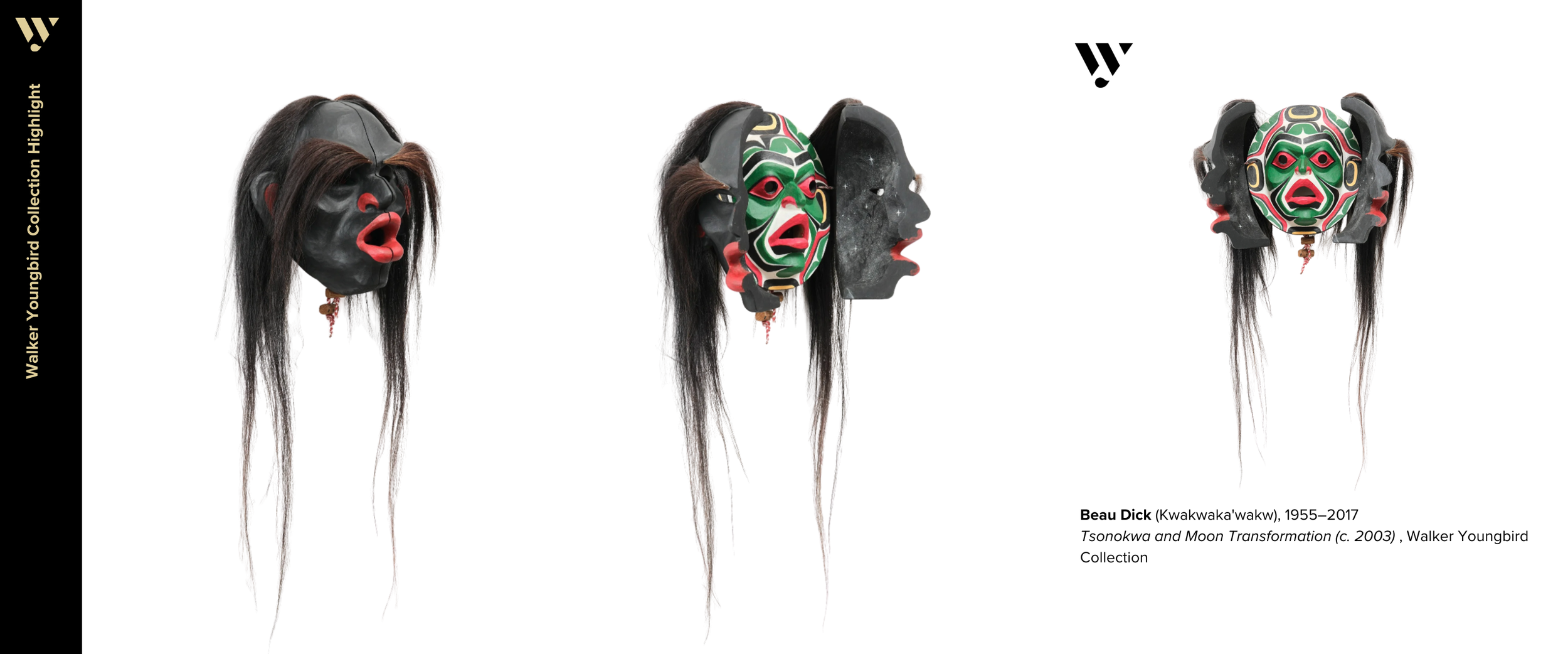
Tsonokwa and the specific work we acquired
RW- Can you tell us more about what drew Beau to this particular mythological pairing, and what does the Moon's role as guardian add to how we should understand Tsonokwa in his hands?
LF- Tsonokwa was a figure Beau returned to again and again, probably more than any other carver of his generation. I think he was drawn to the contradictions within her character — she is frightening, ugly, beautiful, seductive, dangerous, maternal, and vulnerable all at once. Beau loved complexity, and Tsonokwa allowed him endless room to explore it. He would constantly shift and play with her features, emphasizing different aspects of her nature and reminding viewers that these beings are never fixed into a single meaning.
In my time working with Beau, I saw five Tsonokwa transformation masks. Each of those contained a human portrait mask inside, suggesting transformation to and from human form. This is the only example I have encountered in which the inner form is the Moon instead. I have seen Beau incorporate celestial and constellation imagery into other transformation works, but never previously in connection with Tsonokwa.
I never had a direct conversation with Beau specifically about this mask, so I cannot say with certainty why he chose to pair these two forces together here. Beau often preferred to leave space for mystery and interpretation, and he enjoyed creating unexpected connections between things that might initially seem unrelated. At the same time, he was never arbitrary in his decisions. There was always intention beneath the playfulness.
One of the clearest connections between Tsonokwa and the Moon is transformation itself. The Moon carries associations with cycles, tides, change, and movement between spiritual and physical realms. Framing the Moon as a guardian or supernatural chief adds another layer to how we might understand Tsonokwa in Beau’s hands. Rather than presenting her only as a wild or frightening figure, the pairing suggests a more expansive reading — one where she also becomes connected to protection, guidance, and the rhythms that govern both nature and human life.
Beau was always searching for new ways to express ancient knowledge without diminishing its depth. Works like this show how willing he was to experiment within tradition, creating forms that feel both deeply rooted and startlingly contemporary.
Masks as living objects
RW- Beau often said that a mask is not fully activated until it is danced. What does it mean for an institution like the Walker Youngbird Foundation to be a steward of a mask — an object that was made to be worn, moved, and seen by firelight — when it now lives in a collection?
LF- This is an interesting question, and Beau seemed to have a profound understanding of his work moving between realms — both spiritually and physically. He often spoke about the tension involved in taking things out of the “box of treasures,” understanding why some people questioned the movement of ceremonial works into collections and institutions. At the same time, he believed these works had a job to do in the world beyond him. He was confident they would leave his hands and go on to have lives of their own.
Because of that, I think it is important to understand these masks not simply as objects, but as beings. In Beau’s hands they came alive. Yes, a mask is fully activated when danced — when it moves, breathes, hears the drum, and is witnessed in ceremony — but that life does not disappear once it enters a collection. The masks still carry presence. They still perform in their own way because they continue to speak to those dances, those histories, and those spiritual relationships, even while resting on a wall or sitting in storage.
Beau actually preferred the masks to be handled with ungloved hands, something conservators understandably do not always love to hear. For him, touch mattered. Human contact mattered. There was an understanding that these works existed in relationship with people rather than apart from them.
For my own part, I always greet the masks when they are unboxed and thank them both when they come out for display and when they return to storage. I speak to them. That may sound unusual in a museum context, but I think stewardship of works like these requires more than preservation alone. It requires acknowledging that they carry spirit, memory, responsibility, and an ongoing presence. An institution such as the Walker Youngbird Foundation becomes not simply an owner of the work, but a caretaker of a living relationship.
The ceremonial burning and the gift economy
RW- In 2012, Beau removed forty Atlakim masks from a gallery exhibition, returned them to Alert Bay, and had them burned after a final ceremony. That act seems like the opposite of what we usually think art collecting means. How do you hold that philosophy alongside your work as a gallerist and curator — and what do you think Beau would want collectors to understand about what they are truly holding?
LF- As a gallerist and curator, this philosophy has deeply shaped how I understand my role. A gallery is not simply a business centered around one person; it is a community and an ecosystem of relationships. I represent and advocate for artists, staff, collectors, and cultural teachings larger than myself. Because of that, I have a responsibility to think collectively rather than individually. Some of the most meaningful moments for me have been when artists have said, “We have to make sure you are taken care of too.” It is a reminder that we are all bound together within a shared system of care and reciprocity.
Although Beau spoke publicly about the Atłakim many times, parts of the story remain sacred and are not mine to fully recount. What can be shared is that it tells of a young boy who undergoes a transformative journey, encountering forty beings who teach him about life, suffering, healing, nature, and human connection. By the end, he understands that the gifts he has received only have meaning if they are shared with the community.
That philosophy is embedded in the masks themselves. The Atłakim masks are only danced a limited number of times before they are ceremonially burned and returned to the ancestors. Over roughly sixteen to twenty years, a younger generation grows into the role of recreating them, ensuring that both the technical skills and the cultural teachings continue forward. The masks were never intended to exist as permanent art objects. Their meaning comes through use, transformation, disappearance, and renewal.
I think Beau wanted collectors to understand that they are not simply holding an object, but participating in a living system of relationships and responsibilities. The work carries teachings about connectedness, generosity, and continuity. Ownership, in the Western sense, was never really the point. Stewardship, care, and the sharing of knowledge were.
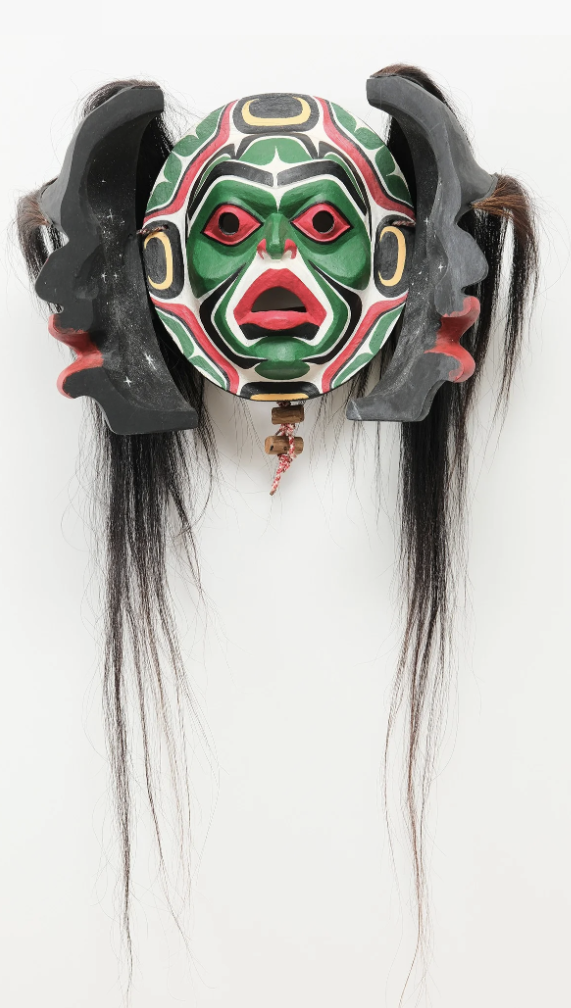
“When Beau looked at a piece of wood, he saw not simply a material but a relationship.”
Documenta 14 and international recognition
RW- As his curatorial coordinator for documenta 14 in Athens and Kassel, you helped bring Beau's work to one of the world's most prestigious platforms — and he passed away just before the opening. What was it about that particular exhibition, with its themes of colonialism and displacement, that made it the right stage for his work? And how did you carry that project forward after his death?
LF- Documenta 14 marked an extraordinary moment in contemporary art history. By that point I had spent nearly two decades working with Indigenous art, particularly Northwest Coast art, and I could never understand why work like Beau Dick’s had been so often excluded from the contemporary conversation. I was frequently told it lacked the kind of social commentary associated with contemporary art, yet to me its very existence was social commentary. It spoke to resilience, survival, and entirely different ways of understanding the world. It carried histories that had long been dismissed or ignored within dominant art narratives.
What made documenta 14 so important was that it created space for those histories and perspectives to stand at the center rather than the margins. Its focus on colonialism, displacement, and alternative knowledge systems made it the perfect context for Beau’s work, which resists easy assimilation and demands engagement on its own terms. For me, it felt like a radical shift in the art world and the fulfillment of something I had sensed the first time I encountered Beau’s work many years earlier and wondered why it was not being recognized internationally.
Beau himself was interested in documenta not simply for personal recognition, but for what it could mean for the broader community. He wanted to bring dancers and activate the masks through performance so audiences could experience them as living works rather than static objects. He was especially excited by the idea of performing in Athens because of the connections he saw between Kwakwaka’wakw ceremonial traditions and early Greek theatre.
Tragically, Beau became seriously ill before the works were completed. In the final weeks, a team of artists and family members came together to help realize the project. Cole Speck, Alan Hunt, Greg Fitch, and Corey Bulpitt moved constantly between Beau’s studio at UBC and the hospital, receiving instructions directly from him, while I handled logistics, customs, shipping, and coordination with documenta. Even then, I still believed Beau would recover and continue shaping the installation himself.
When Beau passed away just days before the opening, it was devastating and surreal. In the midst of grief, all we could think was that we could not let him down on the world stage. We understood that this moment was larger than any one individual — it represented something important for Indigenous artists more broadly.
After Beau’s funeral in Alert Bay, Cole Speck, Alan Hunt, Alexis Nollie, and I travelled immediately to Athens to install the exhibition in time for the opening. We arrived exhausted and grieving, trying to solve countless practical challenges without Beau there to guide us. The masks had never been installed before, and some were highly complex articulated forms that were difficult to mount on the modular stands that had been fabricated months earlier.
As we worked through the installation, I began arranging the masks in ceremonial groupings, almost as if they were preparing for performance. The giant Tsonokwa anchored the space, the Hamat’sa birds framed the entrance, the Atłakim formed an inward-facing circle, and the later works created their own final grouping. The arrangement began to reflect relationships within the stories themselves rather than simply functioning as a museum display. By the end, despite the heartbreak surrounding it, we felt we had created something Beau would have been proud of.
His legacy and what comes next
RW- Beau described his work as being in active opposition to what he called capitalism's "ravenous" oppression — and yet his masks are now in collections worldwide, including ours. How do you think about his legacy today, and what responsibility do institutions and collectors have in ensuring his art continues to teach rather than simply decorate?
LF- I think the beauty of Beau’s legacy is that it does not exist solely in the masks now held in collections and institutions, but also in the people he taught and inspired — artists, carvers, dancers, and community members who will continue carrying that knowledge forward for generations to come. The works themselves are only one part of a much larger living system of teachings, relationships, and cultural continuity.
For my part, I will continue encouraging institutions and collectors not simply to acquire the works, but to engage seriously with the complexities and responsibilities that come with them. Beau’s masks are not neutral decorative objects. They carry histories, teachings, ceremonies, and ways of understanding the world that challenge many of the assumptions of the dominant culture surrounding them.
What is remarkable about Beau’s work is that even within institutional and market systems, it resists easy absorption. The works retain their power. They continue to ask difficult questions about colonialism, ownership, spirituality, community, and our relationship to one another and to nature. In that sense, I believe the masks themselves continue Beau’s resistance. They insist on Indigenous knowledge systems being present and visible within spaces that historically tried to exclude or suppress them.
The responsibility of collectors and institutions, then, is not simply to preserve the objects physically, but to help preserve and support the teachings, relationships, and communities from which they emerge. If the works continue to teach, provoke, and create dialogue, then they are still doing their job.