
Collecting with Purpose | What Remains
Nicholas Galanin's Language removal tools for Indian Children, Mt. Edgecumbe asks what survives after coercion ends, and what a collection is responsible for learning after an object arrives.
Nicholas Galanin's Language removal tools for Indian Children, Mt. Edgecumbe is a pair of iron restraints, small enough for a child, that could be mistaken at first glance for bracelets. Galanin engraved them by hand in formline, the Northwest Coast design tradition he has practiced for decades. Tlingit carvers took up engraving silver and copper bracelets after the church and the settler state suppressed clan tattooing. Galanin put that inherited practice on found restraints.
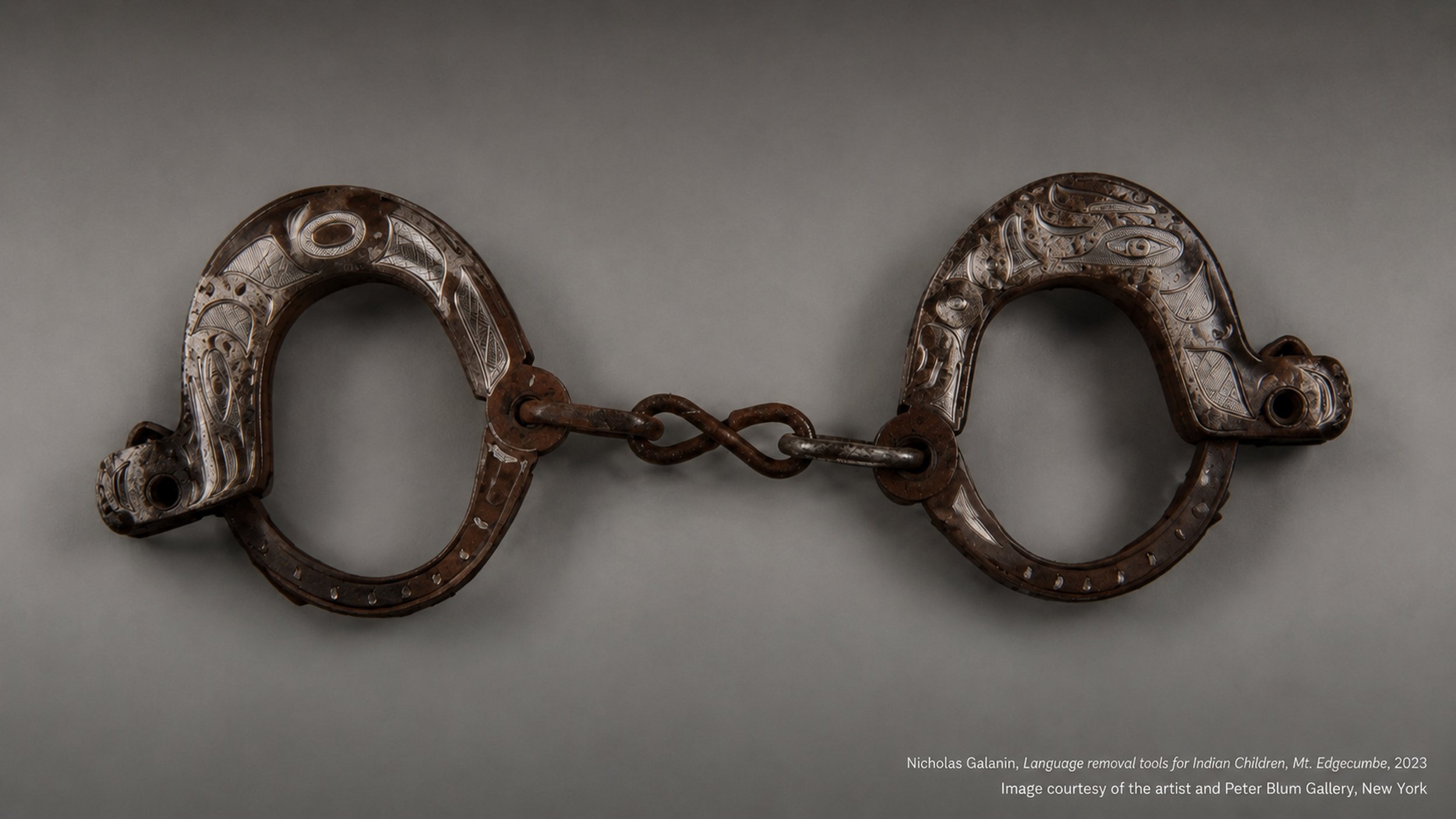
He does not claim these particular objects were used to remove Native children. They are found objects that, in his words, "represent the form and scale of this history." The series grew out of accounts elders shared with him about the removal of Native children to boarding schools.
The Walker Youngbird Foundation acquired the work this year.
The Bracelet
Galanin has worked with this form for more than a decade. In 2014 he made three related works titled Indian Children's Bracelet. The Portland Art Museum holds one, accessioned that year as the gift of Barbara Christy Wagner; the Alaska State Museum holds another; we have not established the location of the third. Their separation is deliberate. Galanin told us it refers to siblings separated from one another by boarding schools. "Separation is part of the work," he said. Bringing them together would resolve that distance into what he called "a neat institutional presentation." We understand our work to be separate from those three, part of the larger series.
Between the 2014 works and ours, the title changed. We asked him why. "The object didn't change," he said. "My relationship to naming it did." Indian Children's Bracelet, he told us, used "the language of institutions, the kind of euphemism that can make violence disappear into an object description." The new title names what the objects were for. "These weren't simply restraints," he said. "They belonged to a larger machinery intended to separate Indigenous children from language, family, culture, and themselves."
"The object didn't change. My relationship to naming it did." — Nicholas Galanin
He also added a place.
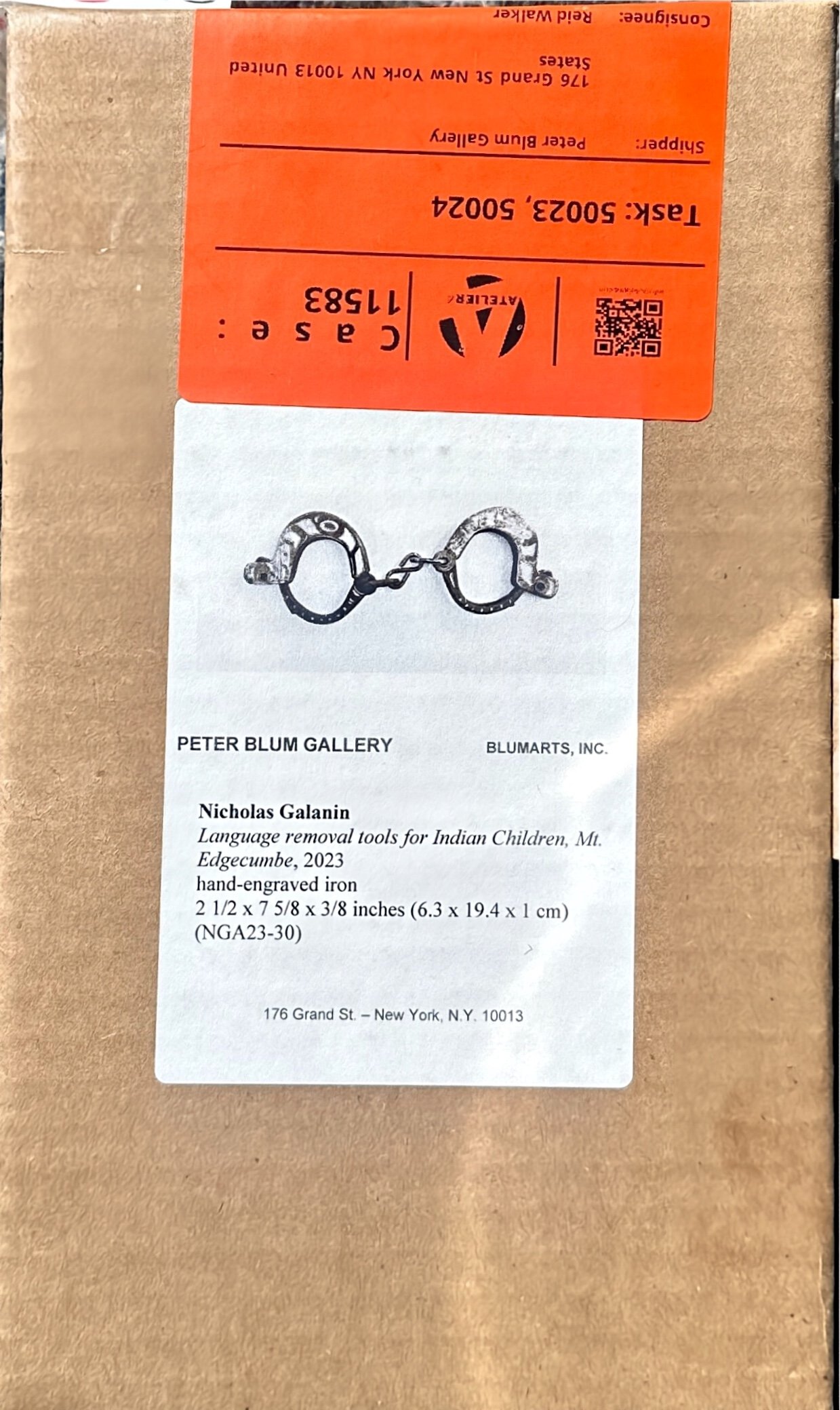
Peter Blum Gallery object label for Language removal tools for Indian Children, Mt. Edgecumbe.
Mt. Edgecumbe
Mt. Edgecumbe High School sits on Japonski Island, across Sitka Harbor from where Galanin lives and works. The Bureau of Indian Affairs opened it in 1947 as a boarding school for Alaska Native students, and the Department of the Interior lists it among the federal Indian boarding schools built to assimilate Native children by removing them from their families, languages, and cultures. The BIA closed the school in 1983. The state reopened it two years later, and it operates today as a public boarding school run by the Alaska Department of Education and Early Development. Attendance is by application, roughly 90 percent of students are Alaska Native, and the school's stated mission emphasizes cultural diversity and tradition; its courses include Native studies, tribal government, and Northwest Coast art.
We found no record of a specific language-suppression policy at Mt. Edgecumbe, and alumni accounts of the school vary.
We asked Galanin why he named a school that still exists rather than one that closed decades ago. "Because it is important to acknowledge that colonization is still ongoing," he said. The institution, he said, carries "a memory and residue" of removal and forced assimilation: the same site, the same name, a Braves mascot, and students who still leave their home communities to attend. He acknowledged that "many students today speak highly of their time at this modern boarding school," but said the history still matters. Education away from home, he said, historically required Native students "to hang up parts of their cultural identity at the door."
He does not claim that a student who applies to a competitive school today is in the same position as a child the government compelled to leave home. His argument is about what remains after the coercion ends. The record establishes the history and the present circumstances. The "memory and residue" Galanin sees in the school is his claim about what those facts mean, and our role is to preserve it as he made it.
"Because it is important to acknowledge that colonization is still ongoing." — Nicholas Galanin
The Surface
Galanin describes engraving as slow work and the pursuit of formline as lifelong. It requires, he said, "attention, connection, understanding, and care." All of that care is spent on an object made to restrain a child. "Any work done around this violent history is heavy," he said. "I don't think that contradiction needs resolving."
The beauty of the work is important to Galanin. "Beauty can bring someone close enough to encounter something they might otherwise turn away from," he told us. The risk is that a viewer admires the engraving and never reaches the object under it or the history in the title. Galanin has called that selective amnesia. "The work asks you to hold both things at once," he said. "If you only see decorations, you haven't finished looking."
"If you only see decorations, you haven't finished looking." — Nicholas Galanin
A collection that holds the work inherits the same problem. Explain too much and the work becomes a lesson. Explain nothing and people can admire the engraving and walk away.
Rereading the Feddersen
This Galanin also made us look again at a work we already had.
Joe Feddersen's Kamloops Residential School, 2024, is a basket twined from waxed linen in a form his people have woven for generations. It stands nine and three-quarter inches. Its surface carries 215 skulls, one for each of the potential unmarked graves reported at the school in 2021, the number Feddersen worked from. Across the top band, in pale linen against black, he wove the name of the school. Feddersen's grandparents attended Kamloops and did not speak about it. He has said he made the basket to understand what had remained silent.
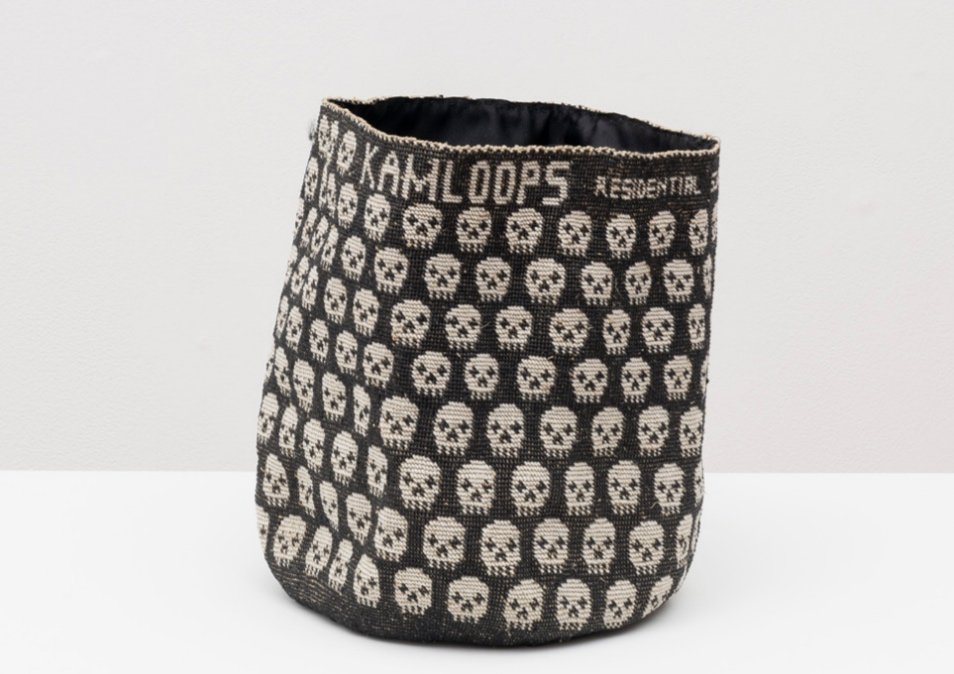
Joe Feddersen, Kamloops Residential School, 2024. Tribes waxed linen, 9¾ x 9 × 9 in. Courtesy 47 Canal.
When we acquired it, we thought of the basket as testimony. Living with the Galanin restraints made that word seem wrong. Feddersen is not passing on what his grandparents told him; he is working around what they did not. His basket is built around what was never said. Galanin's restraints are built around what has not gone away: the title names a school that is still open.
What the two works share is the naming. Galanin dropped a euphemism and put an institution in his title. Feddersen spelled one out in English along the rim of a Plateau basket. Neither left it to a wall label.
What We Thought We Acquired
Collections are good at recording what they know when an object arrives: artist, title, date, medium, dimensions, provenance, price, exhibition history. Interpretation is less orderly. We acquired this Galanin believing we understood its basic proposition. Then we asked the artist questions, and our understanding of what we had acquired changed. That should be an ordinary event in the life of a collection. Too often it is treated as a problem, because once the label is written and the database field is filled, provisional understanding hardens into institutional fact.
As a private foundation, we can say publicly that we may hold a work for years and discover we have been reading it incompletely. Then we have to change the record.
Consider Robert Houle's Afternoon with Rebecca, 2003, which we bought in 2024. Houle, Saulteaux, of Sandy Bay First Nation, survived the residential-school system and later made work directly from that experience. This is not that work. It is what Houle described as an abstract portrait of the artist Rebecca Belmore: one artist painting another. We acquired it as a Houle, which is what it is.
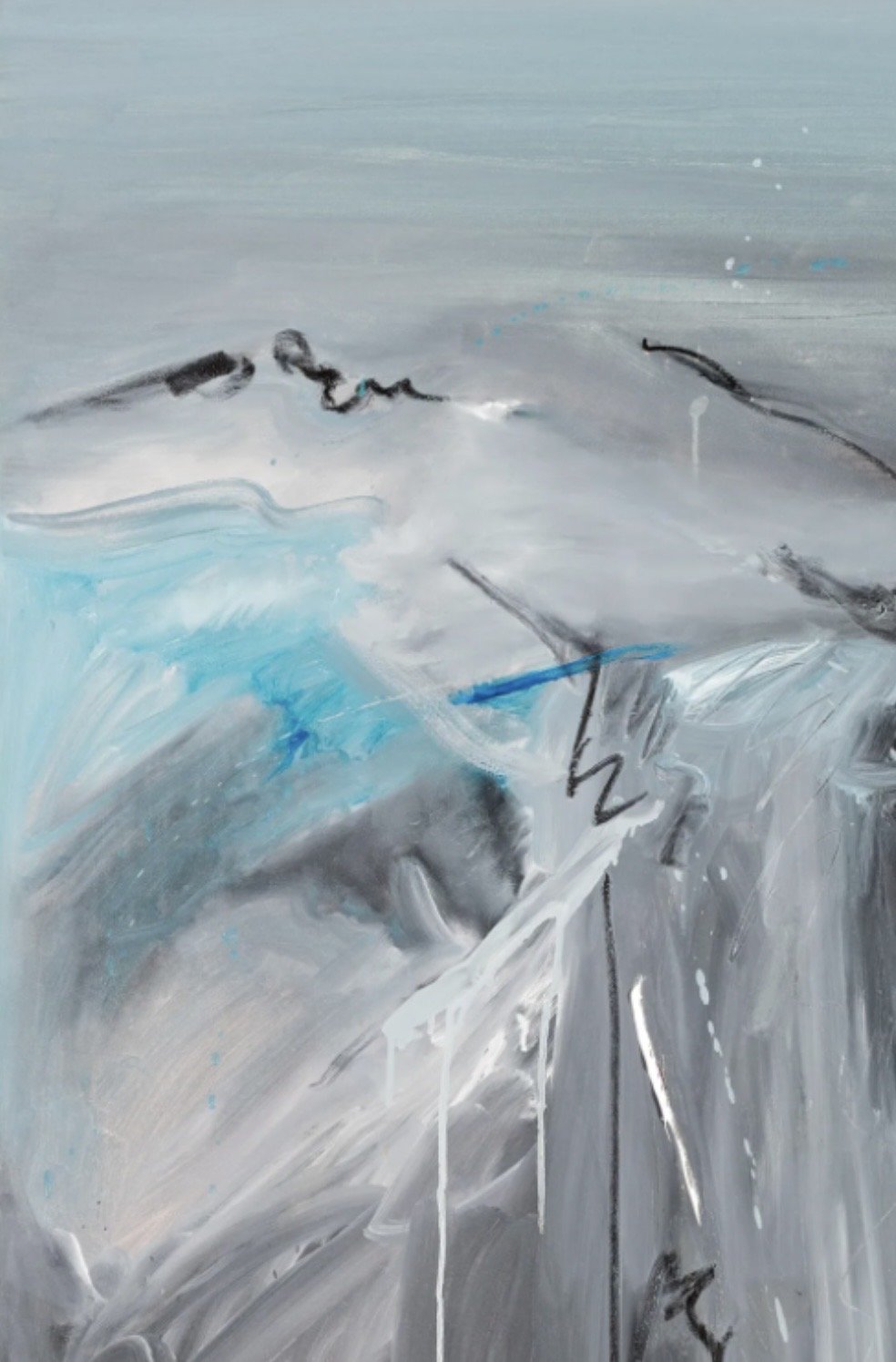
Robert Houle, Afternoon with Rebecca, 2003. Ppl on Canvas, 36 × 40 in.
It reached us through a benefit auction in Toronto in March 2011, held to raise money for Belmore's legal defense after her former dealer sued her for more than CAD 750,000 when she left the gallery and asked for her work back. She needed funds simply to travel to Toronto and appear in her own defense. Artists donated work; Houle donated this painting. The case settled out of court in 2013, and no allegations were proven.
All of that is one line in our provenance field.
Houle knew the problem from the other side. As the first Indigenous curator of contemporary Indigenous art at the National Museum of Man in Ottawa, from 1977 to 1980, he resigned because the museum had nowhere to show the work he had acquired for it.
We bought a painting he gave away to help another artist, and we filed it.
A collection cannot keep everything it learns in a provenance field. It needs a way to record how its understanding changes.
Forward
The Walker Youngbird Foundation will each year publish a rereading of one work already in the collection: what we understood when we acquired it, what we understand now, and what has changed. The first full rereading will be the Houle. We are doing this publicly so that if we don't follow through, it will show.
Beginning with new acquisitions, we will also record what our existing files rarely do: not only what we believe we know about a work, but what remains uncertain, what the artist has asked us to carry with it, and what we may need to ask again.
The record below is where we begin.
Acquisition Note: What We Know Now
Nicholas Galanin, Language removal tools for Indian Children, Mt. Edgecumbe, 2023. Hand-engraved iron. 2½ × 7⅝ × ⅜ in. (6.4 × 19.4 × 1 cm). Signed on verso. Provenance: the artist; Peter Blum Gallery, New York; Walker Youngbird Foundation, Washington, D.C., 2026.
The restraints are found objects. The artist does not claim that these particular objects were used to remove Indigenous children or were used at Mt. Edgecumbe.
Galanin says they represent the form and scale of that history. Accounts shared by elders inspired the series.
The engraving draws on a Tlingit practice of cultural preservation, adaptation, and survival. Galanin describes formline as requiring attention, connection, understanding, and care, in deliberate tension with the function of the objects beneath it.
Galanin previously used the title Indian Children's Bracelet for related works. He says the object did not change; his relationship to naming it did. The later title rejects what he describes as the institutional euphemism of the earlier one and names the larger machinery of language, family, and cultural removal.
Three Indian Children's Bracelet works are intended to remain separated; Galanin says their separation refers to siblings separated through boarding schools. Two are held by the Portland Art Museum and the Alaska State Museum; we have not established the location of the third. We understand the work in our collection to be separate from those three.
Mt. Edgecumbe is not a generic reference to boarding-school history. Galanin deliberately named a school that continues to operate near his home in Sitka. He argues that the institution retains "memory and residue" from the history of removal and forced assimilation, while acknowledging that many contemporary students speak positively about attending it.
Mt. Edgecumbe today is materially different from the institution the BIA operated. Attendance is by application, roughly 90 percent of students are Alaska Native, and the school describes cultural tradition as part of its mission.
The title makes a claim about a living institution. That claim is the artist's. Our responsibility is not to convert it into institutional fact. We can record the artist's claim, test what can be tested, and say where the record stops.
This note records what we know about the work in 2026, including the places where the record does not allow us to know more.